
Exploring Invented Languages
Edgar Rice Burroughs and the Language of Barsoom

Thirty-two years after Percy Greg sent his nameless narrator across the void in an anti-gravity spacecraft - which I explored here, Edgar Rice Burroughs (1875-1950) - of Tarzan fame - found a cheaper way to get a man to Mars: he simply willed him there.
Writing under the name “Norman Bean” to protect his reputation, Burroughs had his first Mars story, “Under the Moon of Mars”, published in the pulp magazine The All-Story February - July 1912. The novel was revised and issued in book form in 1917 under the title A Princess of Mars — the first instalment of Burroughs John Carter on Barsoom series and, not incidentally, Burroughs’s first published story, predating even Tarzan. His hero, the Confederate cavalry officer John Carter, doesn’t fly to Mars. He dies, or seems to, in an Arizona cave, and wakes on the red planet by some unexplained act of psychic transference. It’s a device with a long pedigree — the framing conceit of countless earlier imaginary voyages — but Burroughs bolts it onto something genuinely new: a planetary romance thick with swordplay, monstrous beasts, and princesses in need of rescuing. The genre historians would later coin a term for it — “sword and sorcery in space” — and Burroughs, whether he knew it or not, had written the founding text.
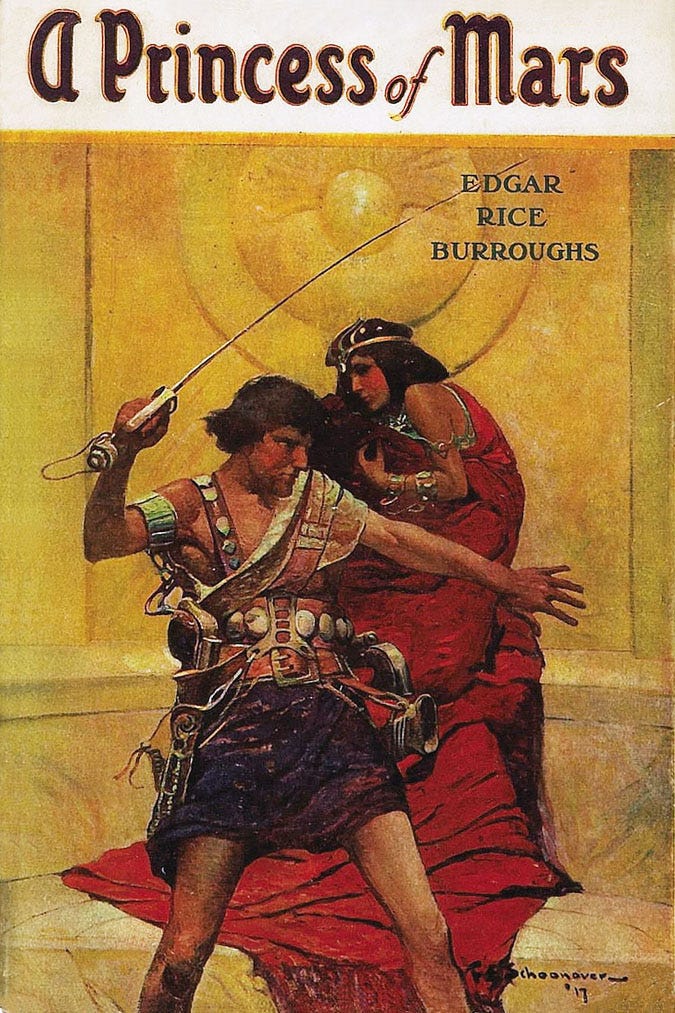
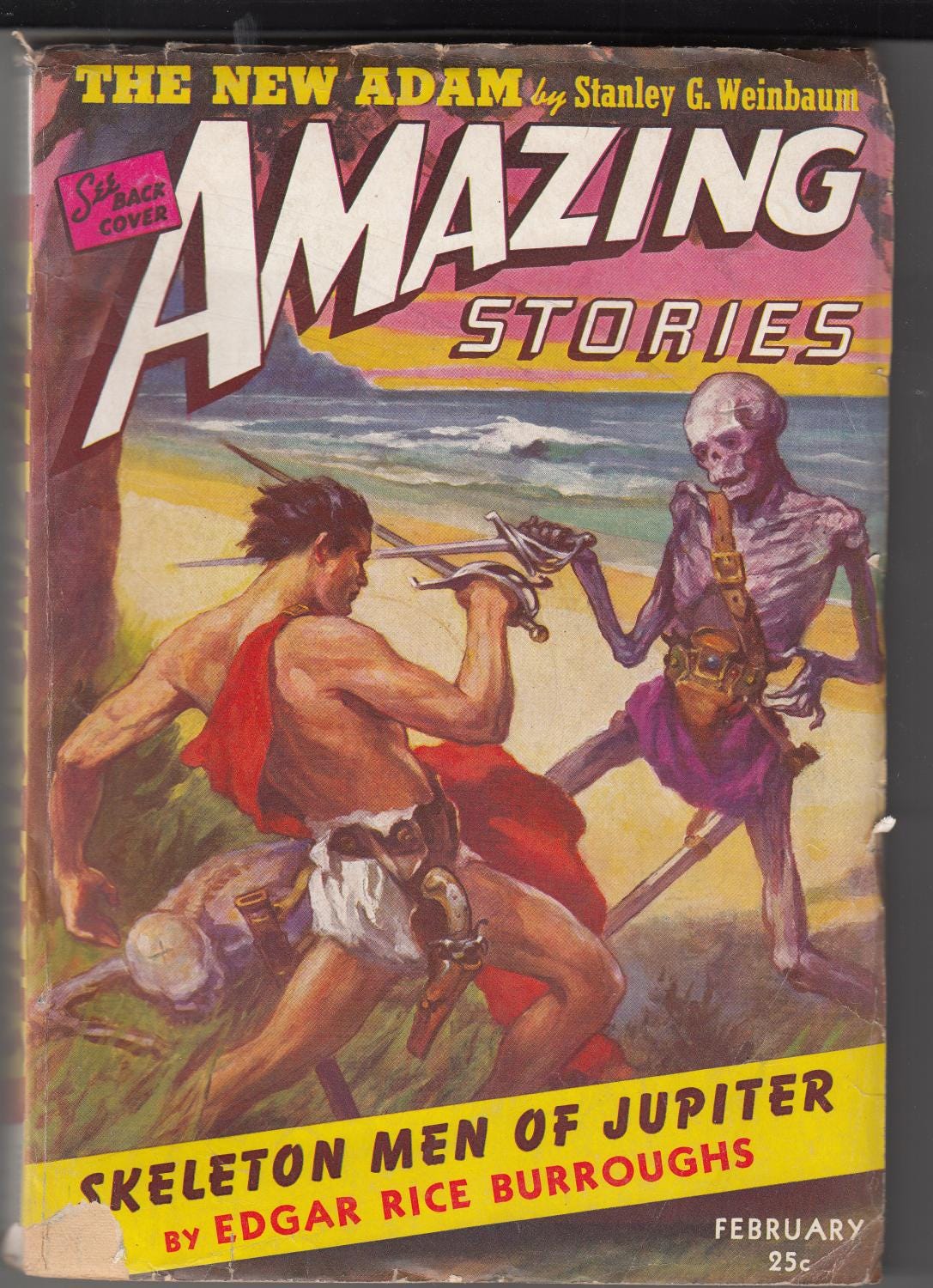
After A Princess of Mars Burroughs kept John Carter’s story running, on and off, for over three decades with The Gods of Mars (1917) and The Warlord of Mars (1919) followed in quick succession, then Thuvia, Maid of Mars (1920), The Chessmen of Mars (1922), The Master Mind of Mars (1928), A Fighting Man of Mars (1931), Swords of Mars (1936), Synthetic Men of Mars (1940), and Llana of Gathol (1948). A final novella, Skeleton Men of Jupiter, appeared in Amazing Stories in 1943, and a last, posthumously assembled volume, John Carter of Mars, followed in 1964. Eleven books in all, spanning 1917 to 1964 — a series that outlived its author by fourteen years.
Barsoomian
The Martians of Burroughs’s Mars don’t call their world Mars. They call it Barsoom, and the language they speak is called Barsoomian. The invented language isn’t built with anything like Greg’s or, later, Tolkien’s philological rigour. In the novels Barsoomian is portrayed as a straightforward spoken language supplemented by telepathy, allowing protagonist John Carter to master it within a week under the tutelage of a Thark warrior.
All Barsoomians speak the same tongue from the ice-clad south to the ice-clad north,” with differences limited to writing systems, such as Helium’s hieroglyphics, while spoken forms remain consistent despite the planet’s millennia-old isolation.
There is no grammar to speak of, no attested sound-system, no serious claim to internal consistency across ten thousand years of invented Martian history. What Burroughs offers instead is what linguists of invented languages sometimes call an “art-language” in the loosest sense: a scatter of proper nouns, titles, place-names, and the odd exclamation, dropped into the text with enough repetition and enough narrative colour that they start to feel inhabited. Barsoom. Helium. Thark. Sak (jump!). Kaor (a greeting). This is world-building through vocabulary rather than through structure — decoration rather than architecture — but it does the job Burroughs needs it to do, which is to make Mars feel foreign without ever slowing the story down.
The greatest source we have for Barsoomian is found at the end of the fourth book. Thuvia, Maid of Mars (1920) which includes a “A GLOSSARY OF NAMES AND TERMS USED IN THE MARTIAN BOOKS”
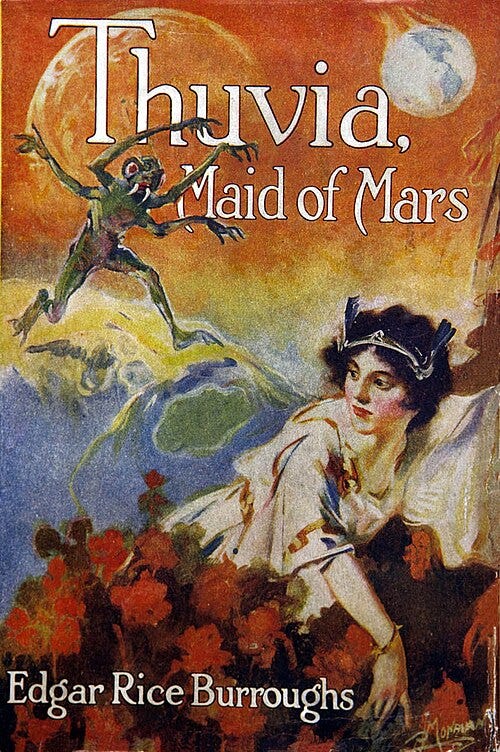
On the face of it, this was a straightforward reference aid — a way for readers to keep the growing cast of place-names and titles straight across an increasingly sprawling series. But as Conley and Cain note in their Encyclopaedia of Fictional and Fantastic Languages (a key resource) the glossary did something beyond translation: it handed readers the raw material to start coining their own Barsoomian phrases (2006, p. 153). This is interesting to compare with the early reader reception of Edward Bulwer-Lytton’s Vril language and readers use of the language to communicate in it at early fan gatherings which I explored here. These early para-textual offerings by authors not only helped define and flesh-out elements of these invented languages but also motivated readers to engage with them - a pattern that will continue as these invented languages for fiction become a key element of reader reception, engagement and development of the world-building of these texts. A closed set of attested words became, in the hands of an engaged fan readership, an open set of buildable ones.
The Barsoomian lexicon in the novels is intentionally sparse, comprising approximately 400 distinct terms across the eleven books, which collectively build an aura of exoticism and otherworldliness without overwhelming the narrative with linguistic detail. Some elements of Barsoomian this para-textual glossary outlines is:
Titles and ranks. Barsoomian society runs on a tidy hierarchy of honorifics: a jeddak is a king or emperor, a jed a lesser king or prince, and a jeddara a queen or empress. Military rank builds on the same root system — a dwar commands a hundred men, an odwar a larger force, a padwar is a junior officer — while a panthan is a soldier of fortune, a paid swordsman without fixed allegiance, and a dator denotes a noble among the Black Pirates of Barsoom.
Creatures. A calot is a Martian dog, fiercely loyal and rather larger and more reptilian than an Earth one — John Carter’s own Barsoomian is named Woola. A thoat is the eight-legged beast of burden the red and green Martians ride in place of horses. A banth is Barsoom’s answer to the lion: an enormous, nearly hairless predator of the dead sea bottoms.
Place and time. The planet itself is Barsoom; its warlike red-and-black capital of the novels’ central conflict is Helium. Time is kept in units with no Earth equivalent — a zode is roughly a Martian hour, a xat a fraction of one — and distance in haads, the Martian mile.
Exclamations and greetings. Kaor serves as a general greeting. Sak — “jump!” — captures the springing, low-gravity gait Carter has to learn on arrival, his Earth muscles giving him startling leaping power under Mars’s weaker pull.
Linguistic patterns in the novels reveal a preference for consonantal endings in nouns, particularly -ar or -or, which lend a rhythmic, alien cadence to titles and roles—evident in “padwar,” “odwar” (captain), and “panthan” (mercenary), recurring in military contexts from The Warlord of Mars to Synthetic Men of Mars. This suffix pattern, used for approximately half the documented nouns, evokes a sense of antiquity and uniformity across Barsoom’s diverse races, while the overall brevity of the lexicon allows Burroughs to prioritise adventure over philological depth. In some cases, we also see, as with Bulwer-Lytton, the use of the agglutinative language model to build words - starting with a root - such as /jed/ - that is then built on through suffixes /jeddak/.
Burroughs never worked out a formal grammar for Barsoomian, and later enthusiasts poring over the novels for consistent syntax have had to do real reconstructive work to find patterns Burroughs himself likely never consciously built in. What he left behind is closer to a very large set of proper nouns and titles than a functioning language — evocative, memorable, entirely serviceable for pulp adventure, but not engineered in the way Greg’s Martial or, later, Tolkien’s Elvish languages were.
Interestingly, the language did eventually get the more rigorous treatment. When Disney adapted the first novel for the sadly poorly received 2012 film John Carter, they brought in the linguist
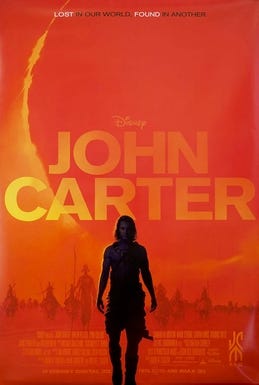
Paul Frommer — already known for having built the invented language of Na’vi for Avatar — to construct a proper Barsoomian conlang with actual phonology and grammar, retrofitted onto Burroughs’s scattered vocabulary a full century after the fact. Fiat Lingua an online magazine of the Language Creation Society (LCS) did a good short interview with Frommer about the invention of the cinematic version of Barsoomian here .
It’s a neat closing of the loop: an art-language that started as pulp decoration, formalised a hundred years later by exactly the kind of professional language-builder Burroughs never was.
Namárië for now!
Love ERB