
Exploring Invented Languages
Language Invention in Early Science Fiction (2) - Percy Greg's - Across the Zodiac (1880)

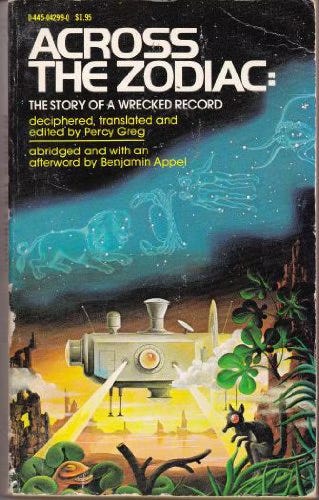
Several years after Edward Bulwer-Lytton published Vril: The Coming Race (1871) which I explored here, author Percy Greg sat down to write Across the Zodiac: The Story of a Wrecked Record (1880) an early science fiction novel which has been called the originator of the “sword and planet” subgenre of science fiction and is the first science fiction novel set primarily on Mars. It is mainly known for the first documented use of the term astronaut which Greg uses in the novel for the name of his traveller’s spacecraft. But for me the most interesting element in this novel is Greg’s invention of the language Martial - arguably one of the first invented language for aliens in fiction.
Who Was Percy Greg?
Percy Greg (1836–1889) is almost entirely remembered—if he’s remembered at all—for his Across the Zodiac: The Story of a Wrecked Record. He was the son of William Rathbone Greg, a prominent Victorian essayist known for his often-controversial writings on social and political topics, and Percy seems to have inherited both his father’s appetite for argument and his willingness to court controversy in print. Greg worked primarily as a journalist and essayist, contributing to periodicals of the day, and built a reputation as a polemicist with strongly conservative, often reactionary views—particularly on race, empire, and social hierarchy. These views do surface uncomfortably in Across the Zodiac itself, where the utopian veneer of Martian civilization gradually gives way to revelations about a rigid, eugenicist social order, reflecting the anxieties and prejudices of Greg’s own political outlook rather than any genuinely emancipatory vision of the future.
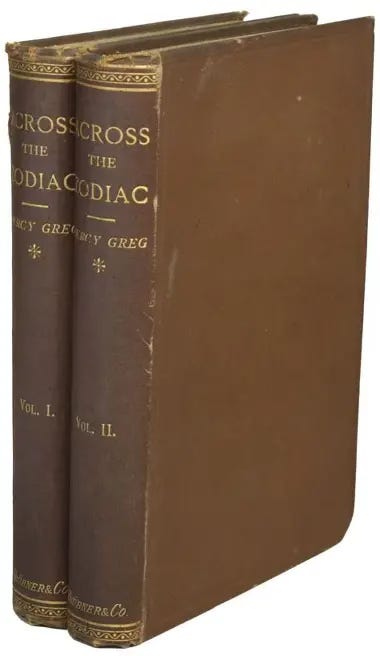
Beyond his single famous foray into scientific romance, Greg’s other major works ranged from domestic novels like The Devil’s Advocate (1878) and Ivy: Cousin and Bride (1881) to his substantial History of the United States (1887), a project that allowed him to expound at length on his views about race, democracy, and the American experiment—views that, predictably, were shaped heavily by his conservative sympathies and skepticism toward republican government. He also wrote on Irish affairs and other contemporary political controversies. In his Into Other Worlds: Space Flight in Fiction, from Lucian to Lewis (1957), Roger Lancelyn Green describes Greg’s work as:
Across the Zodiac, his only venture into other worlds, tells in two fat volumes of a solitary voyage to Mars in the year 1830. The hero, who never gives his name, travelled in one of the largest Space-ships in fiction, with metal walls three feet thick (107)
Upon arriving on Mars, the unknown narrator becomes a prisoner of the Martian inhabitants and encounters the language of Mars which the traveller calls Martial. The description of the narrators time on Mars and the language he learned becomes part of a manuscript conceit account that he writes after later returning to Earth and which Greg supposedly found (long before Tolkien’s The Red Book of Westmarch!).
The Linguistic Architecture of Martial
The clearest evidence of Greg’s language invention ambitions is Chapter V, pointedly titled “Language, Laws and Life,” where Greg essentially pauses the Mars adventure plot to give readers a guided tour of how his invented language, Martial, works. This is a striking authorial choice—most Victorian scientific romances treat alien speech as set dressing, something to be gestured at rather than explained. Greg instead treats it almost as a linguistics lecture embedded in a travelogue, suggesting he saw the language itself as coeval with the story’s intellectual premise, not just its texture.
What makes Martial notable is the sheer architecture of it. Greg gave the language twelve vowels and twenty-seven consonants—a phonemic inventory considerably larger and more deliberately specified than anything readers would have encountered in earlier imaginary-voyage or traveler’s-tale literature. This wasn’t a handful of exotic-sounding syllables strung together for effect; it was a phonological system, the kind of foundational design choice that real linguists make when describing how a language actually sounds and how its words are built from the ground up.
And yet at the same time, Greg’s narrator describes Martial as possessing a simplicity foreshadowing the rise of invented auxiliary languages such as Esperanto (1887) - a planned, regularised language designed for ease of learning and communication rather than one that evolved organically over centuries. As the narrator puts it:
I soon found that, unlike any Terrestrial tongue, the language of the people had not grown but been made—constructed deliberately on set principles, with a view to greatest possible simplicity and the least possible taxation of the memory. There were no exceptions or irregularities and few unnecessary distinctions.
This emphasis on regularity carries through into the grammar. Greg layered onto Martial’s phonology a grammar with real structural ambition, and the grammatical and morphological system—like the agglutinative approach Edward Bulwer-Lytton used for Vril, and which Tolkien would later use for Elvish—builds complex meanings by stacking prefixes and suffixes onto roots. This is the same broad strategy used by real-world languages like Turkish, Finnish, or Swahili, where a single word can pack in what English would need a whole phrase to express. By choosing this design, Greg wasn’t just inventing vocabulary—he was inventing a system for generating vocabulary, one with its own internal rules a careful reader could, in principle, learn to apply.
As the narrator explains, the regularity of the system meant that exposure alone could build fluency:
words were so connected and related that mastery of a few simple grammatical forms and a certain number of roots enabled me to guess at, and by and by feel tolerably sure of, the meaning of a new word.
The verb system illustrates this well. Greg gives Martial six tenses, formed by adding a consonant to the root, and six persons, distinguishing singular and plural, masculine and feminine. The verb “to be” is conjugated as follows:
Iam âva ava
Thou art avo avoo
He/She is avy ave
We are avau avaa
You are avou avu
They are avoi avee
Greg then demonstrates the agglutinative process more fully using the verb root DAC, meaning “to strike”:
daca - I strike - base root + 1st person ending
dak klaftas - a man strikes - 3rd person form with noun
dakny klaftas - a man struck - past tense, suffix -n- (cf. avna, “I have been”)
dakavma klaftas - a man will strike - future tense, suffix -m- (cf. avma, “I shall be”)
One particularly elegant design choice is Greg’s treatment of the passive voice. Rather than building a separate passive construction—as English does with “to be” plus a past participle—Martial simply shifts the pronoun into the accusative case:
daca - I strike - active
dacal - lit. me strike or “I am struck” (passive)
This is a small but telling detail: it shows Greg thinking not just about vocabulary but about how grammatical categories themselves might be organized differently in a constructed language—eliminating a category English treats as essential by redistributing its function elsewhere in the grammar.
Nouns also follow a regular declension pattern. Greg illustrates this using the Martial word for the planet’s creature called a squirrel-monkey:
Nominative Ambâs Ambaus
Accusative Ambâl Ambaul
Dative Ambân Ambaun (to or in)
Ablative Ambâm Ambâum (by or from)
Martial Adjectives are declined like nouns, but Martial dispenses with comparative and superlative forms entirely—another instance of Greg’s narrator-as-linguist pruning away grammatical categories that English speakers tend to assume are universal. Instead, degree is handled through intensifying prefixes, ca and ele, attached to the base adjective.
Finally, Greg gives readers a full sentence of Martial, complete with translation:
Gavart dax Zvelta gavart gedex Zinta — “Never let the member strike, never let the order spare.”
It’s a small sentence, but a telling one—its content (an injunction about discipline and mercy within some kind of social or martial order) hints at the rigid hierarchical society the narrator gradually uncovers over the course of the novel, foreshadowing the book’s darker turn in its second half. The use of the phoneme /z/ may also be used to give the Martial language a slightly alien sound.
Conclusion: Greg’s Place in the History of Invented Languages
Seen against this backdrop, Percy Greg’s achievement in Across the Zodiac comes into sharper focus. The imaginary-voyage tradition he was working within—stretching back through Thomas More, Bishop Godwin, Cyrano de Bergerac, and Swift (among others)—had always used invented worlds as vehicles for satire and philosophical commentary, and as I’ll explore in future posts, many of these earlier works did experiment with invented languages or fragments of them as part of that world-building toolkit. But in nearly all these cases, language remained a minor flourish: a few coined names, an alien word dropped for color, never elevated to the status of a genuine object of study within the text itself.
Greg’s innovation was to take that long-standing impulse—the imaginary voyage’s habit of gesturing toward foreign tongues—and push it to its logical conclusion. By devoting an entire chapter to Martial’s phonology, grammar, verb conjugations, noun declensions, and word-formation rules, he transformed an incidental device into a structural one. Martial isn’t just present in Across the Zodiac; it’s described, with the kind of terminology a philologist would use to describe a real human language. This is why Ekman’s scholarship 1 credits Greg with producing what may be the first artistic language in fiction subjected to genuine linguistic analysis—not simply the first invented words, but the first invented system, complete enough that a reader could, in theory, learn to generate new Martial sentences from its rules (11).
That distinction—between language as ornament and language as system—is the thread connecting Greg to everything that came after him. Edward Bulwer-Lytton’s Vril, published nine years earlier, had shown that an invented vocabulary could carry real cultural weight and aesthetic coherence; to the extent that readers of the novel started engaging with the language elements in gatherings and in the Vril convention held at the Royal Albert Hall in 1891. Greg went further, showing that a constructed language could be taught to the reader, grammar and all, as part of the world-building apparatus itself. In doing so, he anticipated—whether or not later writers ever read him directly—the central insight that would animate the most ambitious language inventors and con-langers of the following centuries.
None of these later figures were likely working in Greg’s shadow—Across the Zodiac sank into obscurity almost immediately, and its reputation today rests on a handful of footnotes rather than wide readership. But Greg’s importance isn’t really about direct influence or a clean line of descent. It’s that he arrived, remarkably early and largely alone, at an idea that the rest of the genre would take nearly a century to rediscover and embrace: that an alien or fantastical world becomes truly inhabited, rather than merely described, when its language has its own grammar, its own logic, its own history embedded in its structure. Long before world-building was a term anyone used, and long before con-langing became a recognisable hobby and even an academic field in its own right, Percy Greg—an obscure, reactionary Victorian polemicist better known for his views on American history than for his fiction—sat down and built a language for Mars, complete with declension tables and irregular-free verb paradigms, simply because he seems to have believed that a planet wasn’t truly real until you could conjugate a verb in its native tongue.
That’s a strange legacy for a strange, flawed, largely forgotten novel. But it’s also, in its way, the moment invented languages in fiction grew up—stopped being decoration, and started being architecture coeval with the story.
The language invention adventure continues
Namárië for now!
Ekman, F: “The Martial Language of Percy Greg”, Invented Languages Summer 2008, p. 11., 2008
What fascinates me is the idea that a world becomes more real when it develops its own language. It made me think about how certain words can carry an entire landscape of meaning within them. Wonderful piece. X