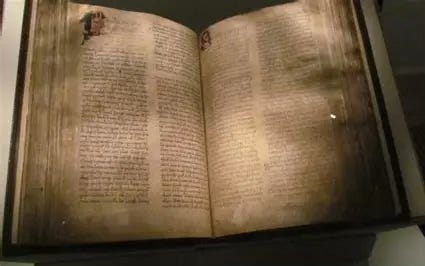
Somewhere in the holdings of Chatsworth House in Derbyshire — the ancestral seat of the Dukes of Devonshire — sits the Book of Lismore also known as the Book of Mac Carthaigh Riabhach, created in the late 15th century at Kilbrittain, County Cork, Ireland, for Fínghean Mac Carthaigh, Lord of Carbery (1478–1505). This manuscript is a vital representation of Gaelic literature and culture, showcasing the literary tastes of the aristocracy during this period.
Thanks for reading Dr. Andrew Higgins Elvish Musings ! Subscribe for free to receive new posts and support my work.
Tucked inside it is one of the most extraordinary texts in all of early medieval literature: In Tenga Bithnúa, “The Ever-New Tongue.” (ITB)
fo. 46 a, 1–fo. 52 a, 2. A tractate in reddish ink, entitled in black ink, Teanga bhithnua annso ‘the Evernew Tongue here below.’ [...] This curious composition is a dialogue between the sapientes Ebreorum and the spirit of Philip the Apostle,
The text composed in the 9th or 10th centuries in Ireland is a cosmological revelation, ostensibly delivered by the soul of the Apostle Philip to an assembly of Eastern kings and bishops on Mount Zion. Philip descends in a bolt of spinning light. He speaks. And what he speaks, for selected passages throughout the text, is in a language no one on earth recognises — because no one on earth invented it except the anonymous Irish author writing it down. This post is about this seemingly invented language: what it looks like, what we can say about its structure, and what it tells us about the extraordinary imagination of early Irish religious writing.
In Christian tradition, Philip the Apostle was one of the Twelve Apostles of Jesus, known for introducing Nathanael to Christ and serving as a bridge to Greek-speaking communities. In apocalyptic discourse Philip plays a major role especially in Egyptian/Coptic tradition. One of the sources for ITB may have been The Acts of Philip a mid to late 4th century C.E. apocryphal text detailing the miraculous deeds and teachings of the Apostle Philip, highlighting his role in spreading Christianity in the early church. In the Irish tradition which drew upon by this text, Philip’s martyrdom takes a gruesome and theologically pointed form: when he attempts to preach the word of God, the pagans cut out his tongue, not once but nine times, in an attempt to silence his preaching. Each time, the tongue grows back. He is therefore called in Irish In Tenga Bithnúa — the Ever-New Tongue — by the company of heaven and in ITB he is referred to by this name. In the text Philip proclaims:
That is my name Philip the apostle. The Lord sent me to the tribes of the pagans, to preach to them. Nine times my tongue was cut from my head by the pagans, and nine time I was I persisted in preaching again; therefore I am called the Ever-New-Tongue by the company of heaven….The language in which I speak to you is that in which the angels speak, and every rank of heaven. (Carey, p. 113)
The symbolism is dense and deliberate. A tongue that cannot be silenced, that perpetually renews itself, is the ideal vessel for a text that claims to reveal the mysteries of all creation in a language that surpasses human speech. When Philip opens his mouth in this text, he speaks first in the angelic language, and then — generously and similar to Tolkien’s practice — the text provides a translation.
ITB has been the subject of study by several key scholars - including the Medievalist scholar and horror and supernatural writer M.R. James (1862-1936) who explored this text in the Journal of Theological Studies in 1919. In 1905 the “Celtic” philologist Whitley Stokes (1830-1909) published a study of The Evernew Tongue in the magazine Eriu a periodical devoted to Irish philology and literature.
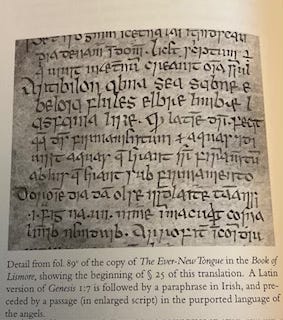
The angelic speech appears throughout the text in enlarged script in the Book of Lismore, visually distinguished from the surrounding Old Irish — a scribal convention typically used to mark primary text from gloss and commentary. This typographical choice matters: whoever prepared the manuscript considered these passages primary, not ornamental. The text also frames the language explicitly. Philip tells his assembly:
“The language in which I speak to you is that in which the angels speak, and every rank in heaven. And sea-creatures and beasts and cattle and birds and serpents and demons understand it, and that is the language which all will speak at the Judgement.”
Here are some of the key passages, with their translations as given in the text:
Passage 8:
“Hæli habíafelbe fæ niteia temnibisse salis sal” — “Listen to this tale, sons of men. I have been sent from God to speak to you.” Which is followed by this passage which gives more insight into the language - …Immediately weakness and fear fell upon the hosts…The sound of the voice was resounding like the shout of an army, but at the same time it was brighter and clearer than the voices of men. It roars above the encampment like the howling of men, which at the same time was no louder in each man’s ear than the words of a friend; and it was sweeter than music.” (Carey, pp. 112-113)
Passage 10:
“Nathire uimbæ uaun nimbisse tiron tibia ambiase sau fimblia febe able fuan” — “It was among the peoples of the earth indeed that I was born; and I was conceived from the union of man and woman.”
Passage 16:
“Læ uide fodea tabo abelia albe fab” — “In the Beginning, God made heaven and earth.”
Passage 25:
“Artibilon alma sea sabne ebeloia flules elbiæ limbæ lasfania lire” — “And God also made the firmament between the waters, and divided the waters which were above the firmament from those which were beneath the firmament.” (see MS below)
Passage 74:
“Efi lia lasien ferosa filera leus dissia nimbile nue bua faune intoria tebnæ” — “Let us make man according to our image and likeness, and let him be over the fish of the sea and the birds of the air and the beasts of the whole earth.”
What can we posit about the structure the language from these passages?
Phonology and sound patterning. The most immediately striking feature of the angelic language is its sonic texture. The passages are dominated by liquid consonants (l, r), labials (f, b, p), and nasal sounds (m, n). Fricatives appear frequently, often in the combination -mb-, -nb-, -lb-. Vowels tend toward short a, e, and i, with the ae ligature appearing with notable regularity. The resulting soundscape is simultaneously alien and strangely musical suggesting a Tolkienian sound-sense to the invented words — it does not sound like Old Irish, nor like Latin, nor like Hebrew or Greek, yet it is not entirely unlike any of them.
Interestingly, Whitley Stokes, initially suspected the language might be a form of Hebrew. He was so uncertain that he sent a copy to Moses Gaster, one of the foremost scholars of Jewish and Oriental languages of the age. Gaster’s response, in a 1906 letter, is itself a small masterpiece of scholarly candour:
“The gibberish, or the language of the Angels, to which you draw attention, is not Hebrew. I for a while thought it might be Arabic, but on looking again very carefully I had to give up on that idea…my belief is that we are dealing here with a remnant of that old heretical literature which is full of names and sentences in a mysterious, or so called sacred language.”
Recurring vocabulary. The notes in the source material identify a small but meaningful set of words appearing across multiple passages:
alea — passages 64, 73
fuan — passages 10, 16, 87
nistien — passages 55, 64
tibon — passages 16, 62, 87
uide — passages 16, 64
The recurrence of these words across passages with entirely different translations is one of the most intriguing features of the language. If the author were simply inventing random-sounding syllables to fill space, we would not expect any consistent vocabulary to emerge. The recurrence suggests either a genuine (if invented) internal consistency, or — as Carey has suggested — a compositional method in which pleasing sound-sequences, once articulated, lodged in the author’s memory and were reused. The word fuan, for example, appears at the ends of three widely separated passages, almost like a liturgical refrain.
The relationship to translation. One of the most cryptic moments in the text occurs at Passage 16, where after one angelic utterance is translated as “In the Beginning, God made heaven and earth,” a second utterance follows:
“Amble bane bea fanne fa libera salese inbila tibon ale siboma fuan” — “It would be tedious to recount in Hebrew everything which is related in that.”
Carey’s note on this is economical but suggestive: “The idea is evidently that the angelic language can express a great deal in a brief compass.” In other words, the author is making a claim that the angelic language is not just alternative notation for human speech — it is denser, more information-rich; suggesting the search for a perfect language to express ideas (see Eco,1995). A short string of angelic syllables encodes what would require extensive Hebrew (or Irish, or Latin) to express. This is a sophisticated theological and linguistic idea, and it gives the invented language a structural rationale beyond mere atmosphere.
The Italian scholar Melita Cataldi offered what remains one of the most evocative descriptions of the angelic language’s compositional logic:
It is a mellifluous idiom which seems to carry the echo of liturgical utterances, invented by phonetic free association, born of the pleasure of playing with assonances and alliterations; and it is the first attested example in the post-classical era of ‘nonexistent language’. In this is expressed the utopia of a unique language — primordial, underlying and ultimate — which survives the confusio of the languages after Babel and holds them bound in a mysterious unity of origin and destiny. (cited from Carey, p. 58)
The phrase “phonetic free association” is key here. Carey himself describes the compositional method in similar terms: “Sound sequences pleasing to the ear would be repeated with variation again and again; individual words articulated might lodge in the memory and be reused.” (57) This is a description not of careful lexical invention, but of something closer to improvised chant, to the spontaneous generation of language-like sound under creative or devotional pressure. This places the angelic language of In Tenga Bithnúa in a fascinating comparative relationship with glossolalia — the phenomenon of “speaking in tongues” found across religious traditions from early Christianity to contemporary Pentecostalism. Linguist William J. Samarin’s foundational research on glossolalia found that while such speech resembles human language in intonation, rhythm, and the use of pauses, it typically lacks consistent lexical structure. More tellingly, when Samarin asked subjects to simply invent a language on the spot, the results were strikingly similar to naturally occurring glossolalia — suggesting that a certain kind of pleasurable, trance-adjacent phonetic improvisation is a natural human capacity. We will explore this further in one of my next Exploring Invented Languages posts on the “Lingua ignota” language invented by the patron saint of language inventors the 12th century abbess Hildegard von Bingen (see Higley, 2007).
The angelic language of In Tenga Bithnúa sits at a fascinating midpoint between these two poles. It is more structured than pure glossolalia — it has a vocabulary that recurs, it has consistent phonological preferences, it is deployed in specific textual contexts and given specific translations. Yet it does not appear to be a fully systematic constructed language in the way that the sixteenth-century Enochian of John Dee and Edward Kelley would later attempt to be (more to come on this!)
What the Irish author of In Tenga Bithnúa achieved was something subtler than full conlang construction and something more deliberate than glossolalia. He/She created the impression of a language — phonologically coherent, internally consistent enough to feel systematic, with vocabulary that recurs and thus implies grammar — while leaving the deep structure deliberately opaque. The opacity is the point. A fully decipherable angelic language would be merely a cipher. An entirely random one would be merely gibberish. This one exists in the productive middle ground, where the human auditory imagination fills in the gaps.
Gaster’s instinct about “old heretical literature full of names and sentences in a mysterious sacred language” pointed toward a genuine and rich tradition. The use of divine, celestial, or invented languages in religious texts has a long history in the apocryphal and Gnostic literature of Late Antiquity. Carey cites several of these including the Pistis Sophia which includes a description of Christ’s garment bearing a mysterious inscription in “the writing of those on high” and The Book of the Resurrection of Jesus Christ by Bartholomew the Apostle where the risen Christ and Mary converse in the “language of his divinity” (Carey, p. 53). Carey has argued convincingly that the exemplar of In Tenga Bithnúa “bears many signs of Egyptian and Gnostic theological influence,” and that this material likely reached Ireland through the apocrypha-collecting Priscillianists of Visigothic Spain — a transmission route that has been explored for how apocryphal material came into early Irish literature. If this is correct, then the angelic language of In Tenga Bithnúa is not a purely Irish invention but the latest flowering of a tradition of invented sacred speech that stretches back through Spain and Egypt to the Late Antique Mediterranean.
The Irish author, however, did something the Egyptian and Gnostic sources largely did not: he provided translations. The angelic language of In Tenga Bithnúa is glossed, explained, made (partially) accessible. This is a characteristically Irish scholarly move — the impulse toward commentary, toward annotation, toward making the esoteric available to the learned community — applied to a genre that traditionally resisted it.
In Tenga Bithnúa has been called by Cataldi “the first attested example in the post-classical era of ‘nonexistent language.’” That is a remarkable claim, and it is worth sitting with. Before Tolkien’s Elvish, before Klingon, before Enochian, before the various invented languages of Renaissance ceremonial magic, an anonymous Irish monastic writer sat down and constructed — however intuitively, however improvisationally — a language for beings beyond the human.
The unknown compiler of ITB did so not as a literary game or a scholarly exercise (as Virgilius Maro may have done as explored in my previous Substack), but in service of a profound theological intuition: that the cosmos has a language, that this language precedes and will outlast all human tongues, that it is spoken by angels and understood by sea-creatures and serpents and demons alike, and that at the last Judgement all creation will speak it together. The invention of the language is an act of devotional imagination — an attempt to gesture toward the transcendent through the very medium the transcendent supposedly surpasses.
The fact that the language is, as Carey’s analysis concludes, “the invention of the compiler” does not diminish this. It may enhance it. An Irish monk, drawing on the traditions of Egyptian apocalyptic writing and the accumulated learning of the early medieval church, reached into his own capacity for phonetic creativity and pulled out something that sounded, to his ear and to the ears of those who would copy and read this manuscript for centuries, like what the angels might say.
Whether or not it is — as Philip claims — the language in which all will speak at the Judgement, it remains one of the most haunting linguistic artifacts of the early medieval world.
Slan agat and Namárië for Now!
Primary Sources
Carey, John, ed. and trans. In Tenga Bithnúa (The Ever-New Tongue). Apocryphes series, vol. 15. Turnhout: Brepols, 2018.
Manuscript Source
The Book of Lismore (Leabhar Mhic Cárthaigh Riabhaigh). Chatsworth House, Devonshire Collection. c. 1408–1411.
Early Scholarship on the Text
Stokes, Whitley. “The Evernew Tongue.” Ériu 2 (1905): 96–162. [The foundational edition and translation]
James, M.R. “The Evernew Tongue.” Journal of Theological Studies (1919). [Stokes corresponded with James on the text]
Gaster, Moses. Letter to Whitley Stokes on the angelic language. 1906. [Cited in Carey’s edition]
On Apocrypha and Early Irish Literature
Dumville, David. “Biblical Apocrypha and the Early Irish: A Preliminary Investigation.” Proceedings of the Royal Irish Academy 73C (1973): 299–338. [Essential for the Priscillianist transmission argument]
McNamara, Martin. The Apocrypha in the Irish Church. Dublin: Dublin Institute for Advanced Studies, 1975.
Herbert, Máire, and Martin McNamara, eds. Irish Biblical Apocrypha. Edinburgh: T&T Clark, 1989.
On the Egyptian and Gnostic Background
Schmidt, Carl, and Violet MacDermot, eds. The Books of Jeu and the Untitled Text in the Bruce Codex. Leiden: Brill, 1978.
Betz, Hans Dieter, ed. The Greek Magical Papyri in Translation. Chicago: University of Chicago Press, 1986. [For the voces magicae tradition]
On Invented and Sacred Languages
Laycock, Donald. The Complete Enochian Dictionary. York Beach: Weiser, 1994. [Contains Laycock’s phonological analysis of Dee’s angelic language]
Eco, Umberto. The Search for the Perfect Language. Oxford: Blackwell, 1995. [Places invented sacred languages in a broader European intellectual history — not specific to ITB but highly relevant context]
Higley, Sarah L. Hildegard of Bingen’s Unknown Language: An Edition, Translation, and Discussion. Medieval and Renaissance Texts and Studies 2007. Fantastic study that I will be revisiting in future posts.
On Glossolalia and Invented Speech
Samarin, William J. Tongues of Men and Angels: The Religious Language of Pentecostalism. New York: Macmillan, 1972. [The foundational linguistic study of glossolalia]
Goodman, Felicitas D. Speaking in Tongues: A Cross-Cultural Study of Glossolalia. Chicago: University of Chicago Press, 1972.
Thanks for reading Dr. Andrew Higgins Elvish Musings ! Subscribe for free to receive new posts and support my work.
This was fascinating to read. Most of it I am not qualified to comment on but I did wonder how someone like Tolkien might have invented languages if he had been born in an earlier era. Maybe like this Irish scribe? And I did wonder at the significance of cutting out tongues nine times (number symbolism is a perilous realm to tread in, but some surprising connections can emerge).


This was fascinating to read. Most of it I am not qualified to comment on but I did wonder how someone like Tolkien might have invented languages if he had been born in an earlier era. Maybe like this Irish scribe? And I did wonder at the significance of cutting out tongues nine times (number symbolism is a perilous realm to tread in, but some surprising connections can emerge).