
Exploring Invented Languages
The Vril-ya - Language Invention in Early Science Fiction

Before I head off back over the pond to Michigan to give a new Tolkien language paper at the Western Michigan University International Medieval Conference as part of the Tolkien at Kalamazoo Group - I wanted to get out my next sub-stack on exploring invented languages - and this time we are going to explore how a Victorian novel about subterranean angels gave the world a constructed language, a beef drink, and — improbably — the blueprint for the modern fan convention.
The traveller’s tale has always required its share of linguistic theatre. From Gulliver’s Travels to the embellished accounts of Renaissance-era explorers, authors have long understood that nothing lends credibility to an imagined place quite like its own language. When the scientific romance emerged as a recognisable genre during the Victorian era, its writers inherited this tradition — and, as we shall see, transformed it into something altogether more ambitious.
No work illustrates this transformation more vividly than Edward Bulwer-Lytton’s 1871 Vril The Coming Race.
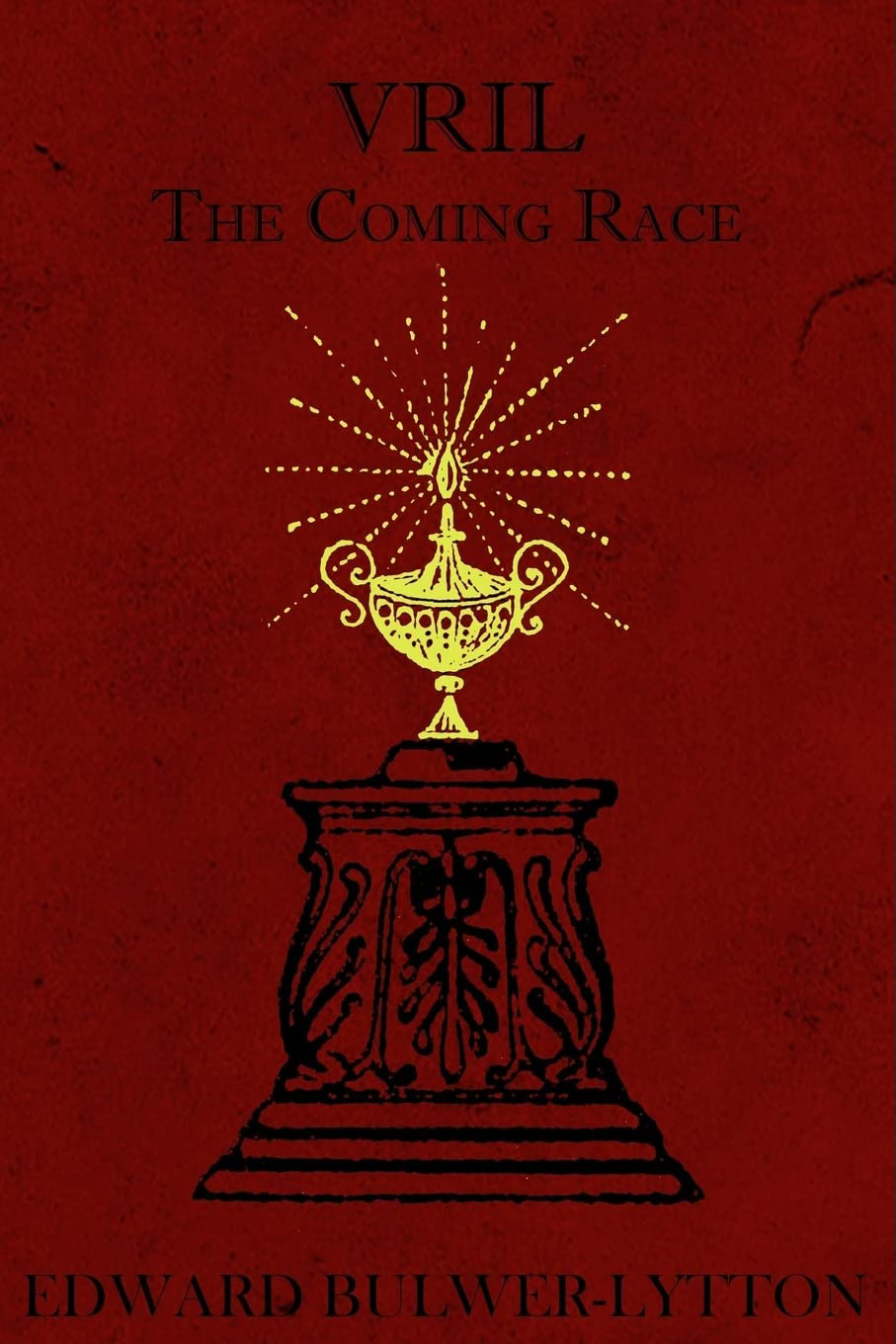
It is a novel that began as a satirical fiction, became a cultural phenomenon, inspired a range of occult movements, lent its name to a popular beef drink, and — most remarkably for our purposes — generated what may have been the first systematically described invented language in the history of science fiction. Its influence reaches forward through a century of world-building, all the way to Tolkien’s Elvish, Okrand’s Klingon, and Peterson’s Dothraki and High Valyrian.
The plot of The Coming Race is easily summarised. An anonymous American narrator, visiting a friend who is a mining engineer, accompanies him down a natural chasm exposed by an exploratory shaft. The engineer falls to his death when a grappling hook dislodges; the narrator, unable to climb back out, makes his way into a vast underground world occupied by beings who seem, in some respects, to resemble angels. These are the Vril-ya.
The Vril-ya are descendants of an ancient civilisation, and the source of their extraordinary powers is an all-permeating fluid called Vril — a force Bulwer-Lytton conceived as a kind of unified field energy encompassing electricity, magnetism, and what he called “atmospheric magnetism” (slightly reminiscent of The Force?) The Vril-ya can manipulate weather, influence minds (“you don’t need to see their papers”), and heal or destroy, all through disciplined command of this force. They are, in almost every respect, superior to surface humanity — and the narrator gradually understands that their eventual emergence from below the earth would pose an existential challenge to the world above.
The novel is a work of considerable intellectual ambition. Contemporary critics ranked it alongside More’s Utopia and Swift’s Gulliver’s Travels. It ranges freely across questions of evolution, electromagnetism, gender politics, and the philosophy of language — and it is on this last subject that it makes its most lasting contribution to the genre.
Bulwer-Lytton devotes almost an entire chapter — Chapter XII — to the grammar, vocabulary, and syntax of the Vril-ya tongue. Far from mere window-dressing, the language is presented as a site of genuine intellectual interest, anchored in the cutting-edge philological debates of the day.
At its opening, the narrator invokes the work of Max Müller, Oxford’s first professor of comparative philology, whose enormously popular Lectures on the Science of Language — published between 1861 and 1864 and reprinted fifteen times before the century’s end — had made questions of linguistic origin and development a matter of widespread public fascination.
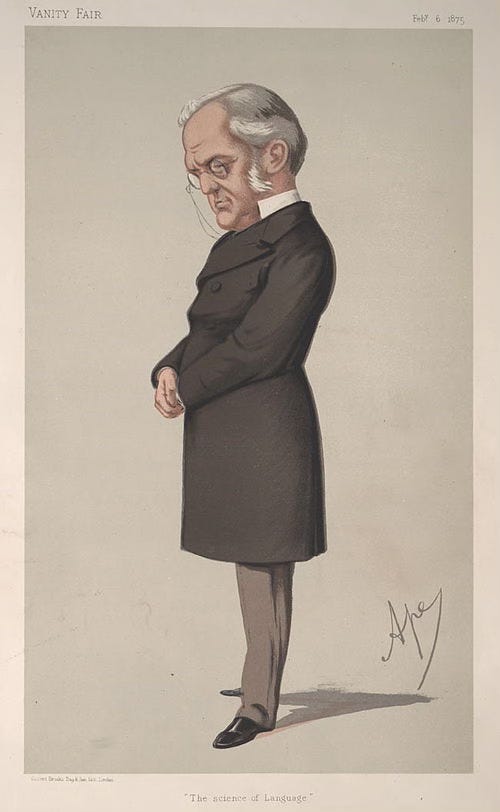
Müller had argued that language passed through three developmental strata — isolating, agglutinative, and inflectional — and that no tongue could skip a stage, just as no geological formation could skip a stratum of rock. This is mirrored in the narrator’s description of the Vril-ya language:
“The language of the Vril-ya is peculiarly interesting, because it seems to me to exhibit with great clearness the traces of the three main transitions through which language passes in attaining to perfection of form.”
Bulwer-Lytton uses the Vril language to dramatise precisely this theory. The language bears within it the geological strata of its own history: it has evolved; it carries the traces of earlier forms; it is old, and shows its age. In describing it this way, Bulwer-Lytton accomplished something that would become a defining hallmark of the greatest language invention: he gave his constructed tongue not just a grammar but a history, and not just a history but a narrative.
we have in the language of Vril-ya, still “clinging with its roots to the underlying stratum,” the evidence of original isolation. It abounds in monosyllables which are the foundations of the language. The transition into the agglutinative form marks an epoch that must have gradually extended through the ages, the written literature of which has only survived in a few fragments of symbolical mythology and certain pithy sentences which have passed into popular proverbs. With the extant literature of the Vril-ya the inflectional stratum commences. No doubt at that time there must have operated concurrent causes, in the fusion of races by some dominant people, and the rise of some great literary phenomena by which the form of language became arrested and fixed. As the inflectional stage prevailed over the agglutinative, it is surprising to how much more boldly the original roots of the language project from the surface that conceals them. (29)
For readers of Tolkien, this will surely sound immediately familiar. The depth and antiquity of Tolkien’s Elvish languages — the sense that they have been spoken for thousands of years, that they carry within them the record of the ages — was, for Tolkien, among the most important qualities a language could possess. He explicitly described the pleasure of encountering a word that implied a whole history behind it. Bulwer-Lytton’s method anticipates this by seven decades.
Most of Bulwer-Lytton’s actual language invention work is on display in Chapter XII of the novel which is introduced with “The language of the Vril-ya is peculiarly interesting, because it seems to me to exhibit with great clearness the traces of the three main transitions through which language passes in attaining to perfection of form.” Included in this chapter is the description of the declension of the Vril-ya noun:
The word Ana (pronounced broadly ‘Arna’) corresponds with our plural ‘men;’ An (pronounced ‘Arn’), the singular, with ‘man.’ The word for woman is Gy (pronounced hard, as in Guy); it forms itself into Gy-ei for the plural, but the G becomes soft in the plural like Jy-ei. They have a proverb to the effect that this difference in pronunciation is symbolical, for that the female sex is soft in the concrete, but hard to deal with in the individual. The Gy-ei are in the fullest enjoyment of all the rights of equality with males, for which certain philosophers above ground contend.
SINGULAR. PLURAL.
Nom. An, Man, | Nom. Ana, Men.
Dat. Ano, to Man, | Dat. Anoi, to Men.
Ac. Anan, Man, | Ac. Ananda, Men.
Voc. Hil-an, O Man, | Voc. Hil-Ananda, O Men.
He also notes, creating linguistic depth, that in the older Vril-ya literature the dual form existed which is now long obsolete. The genitive form has also by this time become obsolete with the dative case taking its place - to expressive possessiveness the Vril-ya would say the house to a man (instead of “of” a man).
The narrator notes:
‘The philologist will have seen from the above how much the language of the Vril-ya is akin to the Aryan and Indo-Germanic, but, like all languages, it contains words and forms in which transfers from the very opposite sources of speech….Should time be spared me, I may collect into systematic form such knowledge as I acquired of this language during my sojourn amongst the Vril-ya. But what I have already said will perhaps suffice to show to genuine philological students that a language, which preserving so many roots in the aboriginal form, and clearing from the immediate, but transitory polysynthetical stage so many rude incumbrances’ (32)
An analysis of this chapter and other places in the novel where Vril-ya language is used gives the following word forms which are built from roots and modified through prefixes, suffixes and infixes which are the hallmark of an agglutinative language.
Nouns & Core Vocabulary (with associated words)
An Man (singular)
Ana Men (plural)
Sana Mankind
Ansa A multitude of men
Oon A house
Gloon A town (assemblage of houses)
Ata Sorrow
Glata A public calamity
Sila A tone in music
Glaubsil Poetry (lit. invention + musical intonation); abbreviated to Glaubs
Aur-an The health/well-being of a man
Glauran The well-being of the state; the good of the community
A-glauran “The first principle of a community is the good of all” (a political creed)
Nax Darkness
Narl Death
Naria Sin or evil
Nas Uttermost corruption/rot
Veed An immortal spirit
Veedya Immortality
Koom A profound hollow; metaphorically, a cavern
Koom-in A hole
Zi-koom A valley
Koom-zi Vacancy or void
Bodh-koom Ignorance (lit. “knowledge-void”)
Koom-Posh Government of the many; democracy (lit. “Hollow-Bosh”); used pejoratively |
Bodh Knowledge
Too-bodh Philosophy (lit. “cautiously approaching knowledge”)
Pah-bodh False or futile philosophy (lit. “stuff-and-nonsense knowledge”)
Ek Strife
Glek Universal strife
Glek-Nas The degenerate, violent stage of democracy (lit. “universal strife-rot”)
Zummer Lover
Zutze Love
Zuzulia Delight
Poo-pra Disgust (phono-aesthetics?)
Poo-naria Falsehood (lit. the vilest kind of evil)
Iva-zi Eternal goodness
Nan-zi Eternal evil
Hil-ya To travel
Exclamations & Idioms
Pah “Stuff and nonsense!” (contemptuous exclamation) |
Posh / Poosh Contempt mixed with pity (roughly equivalent to “bosh”); untranslatable literally |
The evidence of this vocabulary shows a language that is heavily monosyllabic at its roots, inflectional in its literary form, and highly compressed — a single word can convey meaning that would take whole syllables or sentences in other languages (such as A-glauran).
The Legacy of Vril
By the late nineteenth century, The Coming Race had achieved a second life far beyond the literary. Various occult groups in England and Germany had enthusiastically adopted and embellished Bulwer-Lytton’s mythology, asserting that the Vril-ya were actual survivors of Atlantis in possession of a real cosmic energy. Theosophists including Helena Blavatsky treated the novel as something approaching occult truth. A book published in 1960, The Morning of the Magicians, even suggested that a secret Vril Society had existed in pre-war Berlin — though no historical evidence for such a society has ever been found.
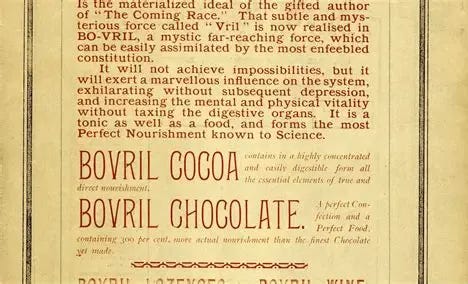
More concretely, the word “Vril” itself entered popular culture with remarkable permanence. John Lawson Johnston, having read The Coming Race, combined “bovine” with “Vril” — the fictional life-force — to name his newly invented beef extract drink. Bovril first appeared commercially in the mid-1880s and remains on British supermarket shelves to this day: a small, durable monument to the cultural reach of a Victorian science fiction novel.

But the most extraordinary evidence of The Coming Race‘s grip on Victorian popular imagination came on 5–10 March 1891, when the Royal Albert Hall in London was transformed into the cavern of the Vril-ya for a five-day costumed fundraiser: the “Coming Race and Vril-Ya Bazaar and Fete”, organised by Herbert Tibbits in aid of the West End Hospital and the School of Massage and Electricity.
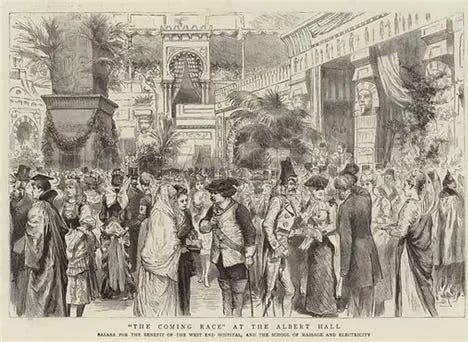
The Hall was decorated with palm leaves, ferns, and a grand Pillar of the Vril-ya modelled on Cleopatra’s Needle — a reference to Bulwer-Lytton’s description of Vril-ya architecture as resembling that of ancient Egypt, Sumeria, and India. Visitors were encouraged to come in fancy dress; many arrived with wings. The character of Princess Zee was played by a young woman wearing a black satin dress with a tiara of electrically lit silver flowers. Winged Vril-ya mannequins were suspended from the ceiling. There were magic shows, a fortune-telling dog, grand feasts, and musical entertainment. And — most significantly for the history of invented languages — printed brochures were distributed containing a glossary of the Vril-ya language, together with conversational phrases that guests could use to greet one another in character.
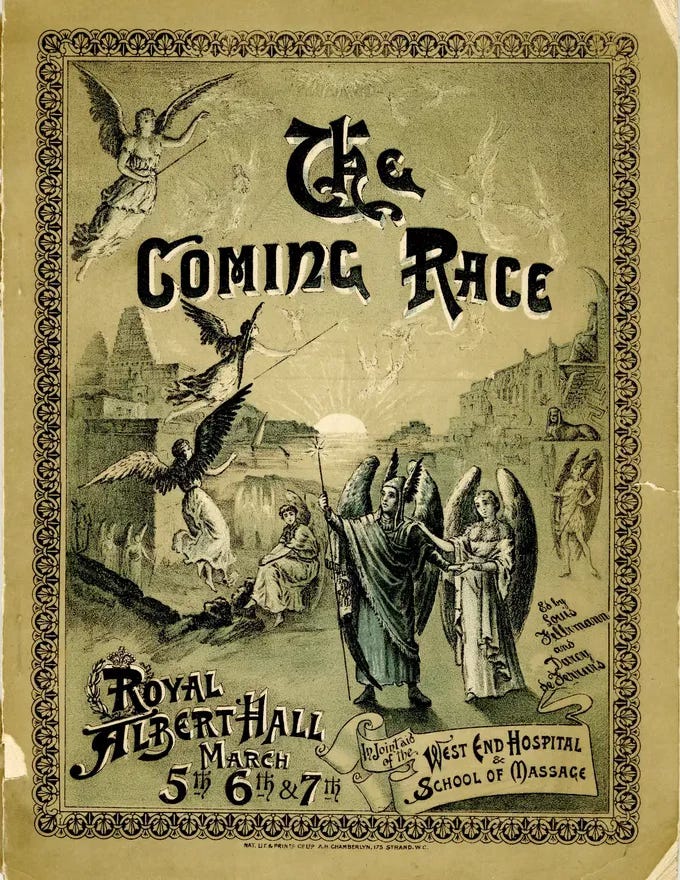
This event was also noted in the literary magazine of the day Punch
PUNCH,
OR THE LONDON CHARIVARI.
Vol. 100.
REVELATIONS OF A REVELLER.
I revelled at the Albert Hall, which last week was given up to a festival called “The Coming Race.” I was there at the opening on Thursday, the 5th, when Princess BEATRICE, attended by her husband, Prince HENRY of Battenberg, declared the Bazaar open. A gay and festive scene. Here, there, and everywhere, Egyptian houses made of cardboard, containing stalls full of the most useful articles imaginable. On the dias, a number of sweet-faced ladies presenting purses (containing 3 3s. and upwards) to the Princess, who received them with an affability which won the hearts of all beholders. On the floor of the building was a gaily-dressed throng, which included many a distinguished person. The revelry continued for three days, and was, I trust, the means of obtaining funds for a charity which, no doubt, is most deserving of support. And here, I may say, I revelled so much at the Albert Hall, that I had no desire to revel anywhere else.
The Royal Albert Hall now describes this event as the world’s first science fiction convention, and the description is apt. The parallel with contemporary practice is striking and precise: a multi-day gathering of enthusiasts in elaborate costume, studying and actively speaking an invented language in a shared fictional space, is exactly what one encounters today at gatherings of Tolkien devotees speaking Elvish, Star Trek fans deploying Klingon, or Game of Thrones enthusiasts practising their Dothraki. The template was set in 1891.
What makes The Coming Race so significant in this history is not merely that it includes an invented language, but the seriousness with which that language is conceived. It is not ornamentation. It is evidence — evidence that the Vril-ya are real, that their civilisation is ancient, that their world has depth. A landscape, however vividly described, remains a painted backdrop. Give it grammar, give it history, give it the friction of translation — and suddenly it breathes and becomes a living artefact that people engage with and even communicate in.
The fan gathering at the Royal Albert Hall in March 1891 — with its glossaries and its costumed revellers exchanging greetings in Vril-ya — tells us something important: invented languages were already, within two decades of The Coming Race‘s publication, not just things to read but things to use. That impulse happily has never gone away.
Namárië for now!